Tuesday, November 06, 2007

Post-agilism (p&p, day 2)

The Agile forest for the Agile trees: too much attention to individual practices than understanding the broad principles; form over substance

Sounds like the difference between "Agile Tragedy" and "Agile Comedy" is communication, practically an encounter session. Telling truths, even when difficult. Bi-directional.

Aha: Agile is about trust, building it, maintaining it, specifically earning it.

Zen agile, neo-agile, postagile... can jettison all 12+ practices and still be little-a agile

Shared understanding of what "done-done" looks like
Empowered, own the problem, it is the team's to suck or shine
Incremental understanding; learn as you go about all aspects of what's going on (including each other, the business area, the customer, etc.)... must accept that you don't know up-front... must seek to learn continuously

Warning signs
  • Silent team room
  • Afraid to change existing code
  • Customer unavailable
  • Don't ship frequently
When off-track
  • Talk talk talk (yay!!)
  • Ask how we'll solve the problem(s) together
  • Guide, don't bully (oops)
  • Gotta listen, too (hmm)
Pair programming reduces context-switching costs: much less likely to interrupt and distract two people who are engaged in an activity than one person when you don't know what they're doing. Context cop(s) important, take (kick) side chatter out of the room... then can be a noisy vigorous team room but will be focused and happy

"Let's say you have an agile team, and you have team members who don't want to be agile. You can't fire them, and you can't promote them. Where can you put them to minimize the damage?" (Ted rules!) It's better to bring them into the team, but if you can't, then you've either got to figure out how to be a team without them, or just don't do the hyper-team thing at all, which is a valid option.

Peter Provost rules!

OMG Steve McConnell (p&p, day 2)

Basic motivations for agile:

Developers: want less overhead, want to focus on "real" work
Customers: want flexibility

Value delivery keeps up with cost

"Especially useful when schedule and resources are fixed, and mission is to provide maximum business value within those constraints"

Agile Manifesto (ca. 2001)

"Reduced emphasis on long-range predictability of features--especially of the combination of cost, schedule and features"

Variation of methodologies is really about the balance of up-front work vs. in-iteration

In-phase defect removal goal is always 100%, at least in theory

Aha: in addition to code defects, can also find requirements defects, architecture/design defects... leaving major testing to end allows build-up of latent defects (all kinds), unexpected fix time

("Evolutionary Delivery" illustrated with arbitrary 25% balance, looks good for us)

Packaged methodologies

XP: developer focused; abandoned more often than retained
Scrum: workflow/management focused; retained more often than abandoned

Few projects use all the practices of a given method; claim of "synergy" among practices is invalid

Useful practices
  • Short release cycles (1-4 weeks): does not have to be externally to the customer; virtually always valuable
  • Rolling-wave planning: long-term (2-12 months); detailed (30-60 days)
  • Timebox development: commit to delivering fixed set of functionality in given timeframe; high morale, visible progress; need a rest period or different activity between sprints
  • Empowered, small, cross-functional teams: include all stakeholders needed to make binding decisions
  • Active management (coach, Scrum Master): "Theory Y" style; remove barriers to good work
  • Coding standards
  • Frequent integration & test: daily build and smoke test (no point building if don't also test that build is OK); note that you don't have to deliver new functionality every day, nor even check code in every day
  • Automated regression test (TDD): virtually always a good practice with new development, problematic for existing/legacy systems
  • Postmortem for each release
Hit or miss
  • Customer-provided acceptance tests: ongoing participation hard to sustain; customer testers don't always know meaningful comprehensive tests
  • Daily stand-up meetings: a good idea that can go too far; less often, shorter, can be OK
  • Simple design: don't oversimplify; must fully satisfy known requirements
  • Test-first development: culture shift is difficult, high discipline required, worth the effort
  • 40-hour work week: we really mean a sustainable pace of work
Problematic
  • System metaphor
  • Onsite customer
  • Collective code ownership
  • Pair programming: good if used selectively
  • Refactoring: prone to abuse
Legacy

Overhyped, buzzwordy, has led to cynicism

Not the best solution for every company, just for many; there are still cases where sequential dev is the best fit

Best outcomes

Importance of short, iterative and/or incremental cycles
Die Waterfall die!
Check-and-balance against overly bureaucratic CMM
Reality check against "omniscience" of requirements, planning, design

In conclusion:

Steve McConnell is a great communicator. I feel like this stuff is really accessible to folks at all tech levels, which makes it helpful for me in taking the Gospel back to our stakeholders.

Monday, November 05, 2007

p&p Parking Lot

Day 1: Architecture

Enterprise Service Bus: complicated. I couldn't figure out how it'd be useful for us.

Scalability: seemed really geared toward high-availability, high-traffic apps, which mine definitely isn't. The advice about degrading services gracefully is helpful, though.

SecPAL: new standard is an oxymoron, it's all game theory figuring out who's going to adopt it and how many peers would need to in order to make it useful.

Day 2: Agile

Does the fact that day 1 was "architecture" make this a "waterfall" conference?

Empirical research on Agile adoption: zzz... I mean, it is awesome, I'll take the deck to work for show-and-tell, seriously. Why's it called a "deck", anyway?

Longitudinal study shows correlation between introduction/adoption of Scrum (specifically) and less overtime (fewer hours and less often). This makes agility interesting for us because the sustainable pace is less negotiable in our environment, while productivity is what flexes...!

Day 3: Development

Totally unable to overcome skepticism of IronRuby. Also, speaker less than riveting. He's talking about IronRuby while presenting on a MacBook. Bwah?

Rocky: "Sharepoint is the new Access!" LOL.

Models: zzz. I suck for not paying attention to this.

Day 4: Software Factories

Microsoft's ill-fitting latte lids, thoughtfully supporting me in my mission to spill coffee on important technology persons. Starting, today, with myself.

In the half hour before the keynote, Scott H popped up a Notepad window over his lead slide, and hacked out a short story about someone at the conference this week actually playing Quake and CounterStrike during the sessions, headphones and all, and finished with the question: how many of you are planning to play CounterStrike during my keynote? About five minutes before his talk began, he ^A-deleted it. Never said a word about it. It was like an Easter egg for presentations.

The entire rest of day 4, so far: my brain hurts. My laptop's brain hurts. My chair's brain hurts.

Swag update: Code Complete 2, Test-Driven Development in Microsoft .NET

Architecture for... me (p&p summit, day 1)

"Pragmatic Architecture"

Demystifying architecture. What is an architect? That person who gets paid more than everybody else and has management fooled? "Architect" == Latin for "cannot code anymore"?

Infrastructure architect, enterprise architect, systems architect.

An architect's areas of concern/decision-making: communication, presentation, state management, processing, resource management, tools.

A higher-level perspective than implementers typically think at.

Addresses the high-level decisions that are really, really difficult to refactor (e.g., changing from WinForms to a web app is not a "refactor").

This stuff seems less frightening this way.

My problem is a lack of vocabulary: patterns, libraries, the specifics. I learn the abstract concepts, the "rules", the grammar a lot more easily. (Linguistics vs. language... the same reason I can't speak more than a few words of French, Russian, Spanish or German today but can describe broad commonalities and differences among them...)

Swag update: cozy p&p summit polar fleece vest.

Day 2 update: "Architecture is that stuff that if you don't do it right, it costs too much to fix."

A good target for stories is not that you can't think of any more to add, but that there's nothing you can take away.

"What do you do with troublesome senior devs who won't cooperate with agile methodologies and can't get along and get in the way of the team?" "Make 'em architects!" [audience LOL. pause.] "Hmm, seriously, that might work."

Star struck (still at p&p, still day 1)

I'm pretty excited about the fact that Steve McConnell is scheduled to deliver tomorrow's keynote address.

I really need to see if I can arrange to spill coffee on him.

p&p, day 1

It's cool to hear a keynote speech in this field and basically understand what it's about.

This morning, LINQ, which seems like a way of replacing inline SQL with inline SQL. OK, not really. LINQ code in C# seems a lot better for maintenance and code clarity, but our speaker mentioned that it encapsulates the "how" away from the "what" and I'm not sure I see how it does that.

I learned a new verb, "to new up" (to instantiate).

Now we're talking about patterns, and our (next) speaker has pointed out that patterns aren't widely used because they are "difficult to contextualize". I like that; it's a highfalutin' way of saying what I've struggled with all along. His analogy, however, that it's like searching for a recipe and getting only a list of ingredients, is funny considering my friend in culinary school has been trained to handle that exact situation and convert the ingredients into a delicious dish. In other words, she's a better patterns architect than I am.

More to come...

Monday, June 11, 2007

Monday, May 21, 2007

Me, on the art of the non-working prototype


The benefit of using a cocktail napkin is that nobody mistakes it for a Boeing 737.

Tuesday, May 08, 2007

As I was saying...

... about the "problem" with, e.g., Mormonism or Scientology:
Bibles is bibles is bibles—and any idiot can write a bible. And so long as people think they can win arguments by writing bibles, idiots are going to keep writing bibles. (Dan Savage, New Jesus vs. Old Jesus)
The "threat" of Mormonism or Scientology or any such "religion" has nothing to do with anything they might believe or practice, but with the fact and circumstance of their existence. Anything so blatantly invented by humans more-or-less within living memory just illustrates how simple it is for an entire, widely accepted faith system to have been blatantly invented by humans.

Thursday, April 12, 2007

Gee! Mail!

Gmail works on my phone now. Word!

Saturday, April 07, 2007

Women's Big Break/LPGA update

I'm relatively new to the world of spectating women's professional golf, so I have no idea whether this is how things usually go. It just seems like LPGA rookies shouldn't miss cuts on the FUTURES Tour.

Ashley Prange: T45, T32
Kristina Tucker: MC, T32

Maybe they're just not focusing on FUTURES events in their training/planning?? Jeanne Cho and Becky Lucidi haven't even competed on the FUTURES yet this season.

At least one former BB contestant is doing pretty well for herself:

Rachel Bailey: T20, T6 (#12 on money list)

Other BBers, so far:

Dana Lacey: T33, T9 (#17, not bad)
Ashley Gomes: MC, T43
Briana Vega: T45, MC
Bridget Dwyer: MC, T50

I had an epiphone about the utility of game shows like The Big Break, based on stuff they've mentioned in passing about some of the contestants on the show(s). In my prior post, I said there were perfectly good "legitimate" routes to the LPGA—the developmental tour and Q School—and while that's true, the problem is they're potentially very expensive. At least a couple of BBers have tried their luck at the game show because they couldn't afford to go pro.

And, it may yet turn out that the developmental tour entry fees in the prize package are a better career boost than the one-time exemptions.

Friday, April 06, 2007

A Picture Share!

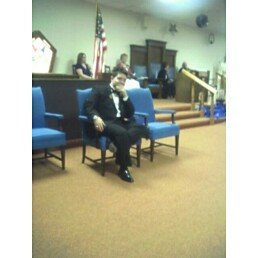
Moblogging this picture of Joe in Chapter, because I can.

(Open meeting, and we were in recess.)

A Picture Share!

So, Google says I can blog and photoblog from my phone. I haven't figured out whether or why I want to, but here goes.

Thursday, March 08, 2007

Let's just say I've been here a long time.

Dear Uptight Seattleite,

My question is, if everyone here seems to be a transplant, are all these transplants just complaining about each other? Everyone always says it is so rare to meet a real live native, so is it really "true Seattleites" that are so bad? Were you born here?

Curious

Dear Curious,

What is that horrible droning from beyond the mountains, getting closer and closer? A plague of angry seagulls? An army of torch-wielding bigots? Oh, wait, never mind, I'm sure you already recognize it. That's right, it's the whining of newcomers. "Seattle is sooo unfriendly! Wah!" I'm just ribbing you, Curious. Really, there's nothing wrong with transplants. Except they all brought their cars with them, and, well, over to you, Harmon Shay, on what that led to. In any case, there certainly isn't some sort of class system based on how long anyone's been here. Even if there were, I wouldn't want to be part of it. I consider myself to be very compassionate toward newcomers. I fully believe in everyone's ability to "get it" eventually. Let's just say I've been here a long time. A really long time. I'd slap my length of time in Seattle up on the table next to anyone else's. Pretty much. Why? Are you from here?

Friday, February 23, 2007

Welcome Archie!

It's Archangelo! Archie for short.

Cool things about Archie:
  • He sings in his sleep.
  • He knows his name and comes running whenever it's spoken.
  • He kisses.
  • He purrs a LOT.
  • I'm still learning the language, but he clearly talks, using different meows for different situations.
  • He plays.
  • He loves to have his tummy rubbed.
  • He doesn't mind sleeping solo.
  • He's fastidious about his litter box, as far as I can tell.
He's just a happy and happy-go-lucky guy. Welcome to the family!

Wednesday, February 21, 2007

Bri fought the cut, and the cut won

The second round of the 2007 SBS Open at Turtle Bay drew to a close on Friday with Big Break VI champion Briana Vega in sole possession of last place with a 17-over-par 161. She'll have another go in October at the Longs Drugs Challenge, plus all those tournaments on the FUTURES Tour, plus whatever she wins on Big Break VII.

Ashley Prange, of course, missed the cut in her lone Big Break V exemption, the 2006 Safeway Classic (+10 154), and Danielle Amiee famously withdrew from her second exemption, the 2005 Corning Classic, after posting a +14 156 at the 2005 Michelob Ultra Open at Kingsmill. (Oh yeah, and the alleged Playboy thing. Those sure looked like her head covers. Ahem!)
ig·no·min·i·ous
Pronunciation: "ig-n&-'mi-nE-&s
Function: adjective
1 : marked with or characterized by disgrace or shame : DISHONORABLE
I've been trying to track down the performances of all the other Big Break winners in their respective exemptions, and that they're so elusive says whatever we need to know. Easy to find the promotional run-up articles, nearly impossible to find the final scores.

OK, granted, I'm a total golf novice, so what do I know, but it seems to me like The Big Break's challenges span every imaginable type of golf shot, a wide range of improbable golf situations, course management, endurance, and psychological pressure. Yes, there's dumb superficial reality show drama, but with very few exceptions one's fate rests with one's ability to make golf shots. I wonder what it is that fails to translate into tournament success?

I guess the main observation is the damning one. Q School and the developmental tours offer pretty straightforward paths to earning status on a major tour, and if these contestants could cut it on those paths, they wouldn't need The Big Break.

Indeed, Kristy McPherson and Sarah Lynn Sargent each earned their 2007 exempt status the old-fashioned way (FUTURES Tour money list and Q School, respectively), and both of them trounced Bri Vega at the SBS even after she "bested" them on BBVI.

Oh well. I'm still gonna watch VII. :)

Tuesday, January 23, 2007

Who will win the DVD format war

Now we know for certain who will win the high-definition DVD format war, Blu-ray or HD-DVD.

New York Times: In Raw World of Sex Movies, High Definition Could Be a View Too Real

The article (entertaining in its own right) contains this little gem:
The pornographers’ progress with HD may also be somewhat slowed by Sony, one of the main backers of the Blu-ray high-definition disc format. Sony said last week that, in keeping with a longstanding policy, it would not mass-produce pornographic videos on behalf of the movie makers.

The decision has forced pornographers to use the competing HD-DVD format or, in some cases, to find companies other than Sony that can manufacture copies of Blu-ray movies.

The movie makers assert that it is shortsighted of Sony to snub them, given how pornography helps technologies spread.
This is exactly right on. It's like trying to build a new super-high-speed armor-plated helicopter and then refusing on principle to sell any to the Department of Defense.

Also, Blu-ray has a silly name. I believe the VHS vs. Betamax war proved that acronyms have a decisive advantage over phonemes.

Saturday, January 20, 2007

Getting rid of postal mail advertising packets

Those advertising and coupon packages that fall apart in my mailbox really make me angry, especially because the packages themselves don't contain any information about how to get rid of them. When I first moved in here, I started calling the "advertise with us!" phone numbers until I reached someone with information about how to get off their lists. I had to make my request in writing by postal mail, and both of them advised that they will only honor a removal for two years!

It's been two years. Grrr.

But, good news! The two offenders that recently showed up, falling apart, in my mailbox, now accept removal requests online! Neither one of them says anything on their site about the two-year limit, but my guess is it's still in effect. They keep hoping you'll sell your house to someone who likes their crap.

As a public service, and a personal reminder for myself in two years, I present:

Remove your address from the ShopWise® mailing list

Remove your address from the ValPak mailing list

Remove your address, phone and/or email from Direct Marketing Association lists¹

__________
¹ Don't hold your breath about spammers honoring your DMA preferences, obviously.

Friday, January 05, 2007

Most euphemistic, indeed

The American Dialect Society votes today on its 2006 Words of the Year, in a variety of categories. This nominee stands out:
MOST EUPHEMISTIC
[...]
waterboarding: an interrogation technique in which the subject is immobilized and doused with water to simulate drowning; reported to be used by U.S. interrogators against terrorism detainees.
So, "waterboarding" is a euphemism.

"Interrogation technique"?

"U.S. interrogators"?

"Detainees"?!

Is this intentional irony, Alanis?

And don't even get me started about how NPR plays along with the administration's Newspeak.

Saturday, December 30, 2006

Reading list updated

I keep a list of what I've read, what I'm reading and what I'm fixin' to read over on my personal site. The pace has slowed way down now that I'm no longer riding the bus to work, and I let the list get stale this fall, but tonight I've updated all my recent reads and re-filled the queue with my latest Borders and Amazon acquisitions.

The underlying code for that page is a bit spaghettish, but I'm pretty pleased with how I was able to get it to come out. (Refresh the page a few times to see my cool parlor trick.) The list data is maintained as an XML file and the page is built using JSP and templates. Maybe I'll look into Web 2.0ifying it this year.

Friday, December 29, 2006

Remembering Jiji

Five Corners Animal Hospital is the 24-hour emergency clinic where we took Jiji on Christmas Eve (and, this summer, had taken Prissy the ancient Maltese when she was hit by a car on a Sunday). As I've recently discussed, I used to volunteer at a similar after-hours emergency clinic. You really have to admire people who are willing to give up their Christmas Eve, and Christmas Day, to make sure that the rest of us have a place to take our pets when they get into the chocolate or the poinsettia, or when we figure out that holding out until Boxing Day was overly optimistic. I euthanized one beloved pet this festive holiday season, but they probably euthanized many more. And, hopefully, saved a few.

VCA Five Corners is a corporate clinic, which I have mixed feelings about. NTEPC is a co-op and I still think their economic model is amazingly cool. But I'm pleased to report that the corporateness doesn't diminish the compassion or professionalism of the staff.

Anyway, on Thursday I got a sympathy card in the mail from Five Corners. That's standard practice and I was pretty much expecting one. What I wasn't expecting was a handmade card inside, decorated all over with hearts and Jiji's name and, in the center, her paw print. Before sending her off to be cremated, they took her paw print. I hardly need to say that I bawled like a baby. I especially loved Jiji's bony little paws, and now I have a life-size memento. I reckon I'll frame the print along with a picture or two of her.

What do you do, I wonder, to say "thanks" to a corporate clinic?

P.S. Thanks, also, to the good friends who gave me a sympathy bouquet today!

Wednesday, December 27, 2006

Five things meme

I'm not normally the meme type, but I have great respect for Eszter's blog and thus I don't take her tap lightly! Hi Eszter!

I talk so darned much all the time that it's hard for me to imagine any information about me that everybody hasn't already been subjected to, but I'll give it a try. :)

1. My mom is deaf. She speaks almost flawlessly and can lipread most people, but I still functioned as an "interpreter" and handled all the family's phone calls from an early age (five or six). I think it may be similar to how second-generation immigrant children translate for their parents. I suspect this is why I'm so talkative and have always been fairly confident speaking up around my elders. I got in trouble with some adults for correcting Mom's pronunciation in public, but she would always reassure me privately that she wanted me to help her speak perfectly and she welcomed those corrections. I wonder if that's why I'm so contrary now. ;)

I don't sign worth a darn, except for the alphabet and "Silent Night", but I lipread pretty well and I normally watch people's mouths, rather than their eyes, when they talk.

2. For several years in my late 20s, I wanted to be a veterinarian. I volunteered at the North Texas Emergency Pet Clinic¹ in the evenings (after working my day job as a software developer). Chuck and I traveled to Texas A&M University for an open house at their CVM, and I spoke with counselors there and at UW about what it would take for me to pick up remedial science credits before applying to vet school. When we moved back to Seattle, I initially took a job as a clinic receptionist. I ended up abandoning my veterinary aspirations when I got a closer look at the challenging economics of clinic practice and, at the same time, got an offer for an obscenely high-paying job as a software consultant.

I adopted Jiji in part because I figured I could at least put my experience to good use taking care of older pets with special needs.

3. I'm an active member of the Order of the Eastern Star and the proprietor of the only, as far as I know, OES blog on the web.

4. I'm a language geek, although I'm quite terrible at actually speaking languages. I have taken classes in French, Russian and Spanish. Russian was the biggest disappointment; I loved it, but after nearly four years of study, these days I can barely remember two words and one children's song. I do read Cyrillic pretty well, though. I'm a huge fan of modern-traditional Scottish Gaelic music and I've learned phonetic Gaelic so I can sing along (and I've done exactly one a cappella Gaelic gig). I picked up a respectable amount of travelers' German on my trip in 2005 and would like to learn more. I mastered exactly two words in Czech, although I was able to muddle through a few more to fend off a would-be suitor at the Prague train station. I've dabbled in Welsh, Japanese, Danish, Cherokee and Latin. I like to study alphabets and pronunciation so I can handle native people- and place-names even in languages I don't know, such as Polish and Hawai'ian. For no apparent reason, I recently decided to collect the Nicene and/or Apostle's Creed in as many languages as possible, which necessitated installing about a hundred new fonts. I'm considering a new, more useful project to document "excuse me", "thank you" and "please" in as many languages as possible, and maybe "hurry!" in case I ever get cast on "The Amazing Race".

5. I play guitar in a startup quasi-bluegrass band.

Tapping Jana, Jim, Cameron, Siri and LG.

______
¹ I created their first website and was surprised to find that a lot of the content they're using today was originally written by me!

Tuesday, December 26, 2006

"He was delicious."


We knew it'd come in handy eventually.

I always thought this was one of the funniest sketches evar on SNL, and I've quoted it regularly ever since. So when the real news finally broke, I found out by someone quoting it back at ME. Thanks to lafe for tracking down the video... I bow to your superior Google-Video-fu....

Monday, December 25, 2006

James Brown IS Dead


Seriously old-school techno. I've owned this track since it was released, I thought longer ago than 1991, but whatever. In spite of its title/chorus, the lyrics do conclude that James Brown is not actually dead.

There were counter-tracks released by other bands: "James Brown Is Still Alive" and "Who the Fuck is James Brown?" This one had to win the rhetorical argument eventually, though, and on Christmas Day 2006, it finally has.

Sunday, December 24, 2006

RIP Jiji, 1988-2006

We euthanized Jiji this morning, on Christmas Eve.

I would have to say that the many stresses of the windstorm and five-day power outage took their toll on her, but so did the cold winter weather and the passage of time in general.

After three full days in the cold at my power-less house, we both found refuge at my sister's cozy apartment in West Seattle. Jiji seemed her usual self for two more days; don't know if she was masking symptoms, or if something more acute happened while we were not looking. We suspect a seizure or a stroke, brought on by the progression of the kidney disease. In any case, when I brought her home on Wednesday night, she was terribly agitated and in real distress. I couldn't find any way to settle her. She spent all day Thursday, overnight, and most of the day Friday at her vet, where they tested for many things and treated many more... all best guesses, as is so much of veterinary work. Two different doctors mentioned "senility", which turned out to be the key.

When I brought her home again on Friday night, she went right back to the same agitated behavior, and that's when we realized that she truly didn't know where she was (and hadn't on Wednesday, either). Her other ailments weren't the cause of her distress. She was lost, confused and probably scared. She didn't know any of her old favorite places in the house, and she started getting into rooms and climbing on things she had never shown any interest in before. It was like having a different, new cat, and it was hard to accept that she wasn't ever going to sit with me in the same way or share any of my favorite interactions again.

But, we hoped, maybe we could help her re-adjust to her home and build a new relationship. In a way, that worked. She was able to settle in, and in a strange way she still seemed to know us... at least, to know that she could trust us and that we loved her. I imagined that she might be trying to figure out how the heck I knew all her favorite spots to be petted. "You taught me," I told her. She started looking for me in my regular place on the sofa, and would come to me when I sat there. She calmed down. She slept, just in new places.

But she still wasn't feeling well, and couldn't bring herself to eat. Loss of appetite is one of the major signs that the kidneys have failed beyond recovery. I came up with my list of enticements, all the things we would try over the next few days to get her eating again, and we tried all of them. Nothing worked. It wasn't just that they didn't work; it was that whenever we went to the kitchen, she would follow us and meow and wait to be fed. She was hungry, and she knew she needed to eat, but when the food was placed in front of her she just couldn't do it. On Saturday night, I mixed some food with water and managed to get her to swallow 2.5 cc's from a syringe, but her heart wasn't in it.

On Christmas Eve morning she let us know that she was really done. She hadn't touched any food overnight, could barely drink water, lurched and wobbled when she tried to walk, and couldn't hold her head up. I had just finished reading about end-of-life for cats and the telltale head drop. I catalogued all the medicines, treatments and techniques I had available to try on her, and couldn't bring myself to subject her to any of them. It was just enough.

I've never actually had to euthanize a pet before, and the thing I hadn't really figured out was that if the purpose of euthanasia is to prevent a pet from suffering, what that means is, you have to make the decision to euthanize before the pet is clearly suffering, in other words, when the pet still seems to be stable and could be "OK" for some indefinite longer time. I'll never know whether she might have been "OK" through Christmas Eve and Christmas Day, but it was very clear she wasn't going to get any better thereafter, and that meant there wasn't anything left to wait for. Our gift to her was peace, and an end to her disease. At the emergency vet, she nuzzled into the crook of my arm and just seemed so, so tired. It was hard to let her go, but she told us it was time.

Jiji lived nearly nineteen years. Her vet's records (dating back before I adopted her) showed she was born in 1988. She was older than my high school diploma. :) No one I know had ever even heard of a nineteen-year-old cat, much less one so companionable in her eighteenth year, much less one who had been indoor-outdoor for the seventeen years before she came to me! Vets were impressed that she made it seventeen full years before showing any signs of CRF, and that she lasted another full year after the disease emerged (the cat's body compensates so well that by the time symptoms become visible, the kidneys are already 75-80% gone). She was a wonderful cat and a perfect companion. I was so lucky to have her for the year that I did.

Rest in peace, Jiji, wherever you are. I love you.

Monday, December 11, 2006

Unisex baby hell

This is how bad it is. As I was shopping for friends' baby shower this weekend, I mentally applauded them for refusing to know in advance the sex of their baby, especially when I discovered how unbelievably difficult it is to find unisex baby clothes. No matter how many times you tell the relatives you prefer unisex, I thought, they're going to get stereotypically gendered stuff out of desperation because there's nothing else here.

It turns out it's worse than that. These same friends had a similarly-situated expectant friend or relative. Her family decided on their own that it would be a boy, and bought it blue boys' clothes anyway. Hmm... but I'm not sure what it proves that when the baby turned out to be a girl, they decided that the boys' clothes couldn't be used and now they're packed away, waiting for someone else in the family to have a boy. If you decide that your "unisex" girl baby "can't" wear "boys' blue"...?

I ended up going empty-handed to the shower because I hated the only unisex I could find and I wanted to take the time to shop better. Today it's looking like the entire mission is a fool's errand. Witness:
Amazon.com >
Apparel & Accessories >
Kids & Baby >
Infant & Toddler >
* Girls
* Boys
* Shoes
Girls, boys, shoes? Surely....
Search >
Infant & Toddler >
"Unisex" >
* "Gerber" Onesie with Matching Cap and Booties (Unisex)
Choose a color:
* Pink
* Blue
I give up. I guess the only way to avoid "gendering" a baby is to let it go naked.

Oh, wait. Hmm. Dammit.


Update: I'm not alone! Rigid lines between boys' things and girls' things removes options

Monday, December 04, 2006

Women's Big Break/LPGA Q School final report

Final standings of Big Break contestants competing at LPGA Q School 2006:

Top 15, earning exempt status:
T10 Sarah Lynn Johnson  BB6  T16  72-73-72-71-70  358  -2
Next 35 and ties, earning non-exempt (conditional) status:
 1  Jeanne Cho          BBV  T19  71-72-72-74-71  360   E
27 Kristina Tucker BBV T50 73-76-71-73-73 366 +6
36 Becky Lucidi BBV T50 77-77-67-72-75 368 +8
37 Ashley Prange BBV T50 69-76-73-75-75 368 +8
Failed to advance to final round:
Ashley Gomes            BB6  CUT  78-76-76-75     305  +17
Also, Big Breakers who failed to advance at Florida Sectional Q School:
Julie Wells             BBV  CUT  80-74           154  +10
Bridget Dwyer BB6 CUT 76-79 155 +11
Dana Lacey BBV CUT 80-76 156 +12
Annie Mallory BB6 DQ 86 86 +14
Nota bene: Kristy McPherson, BB6, already qualified for 2006 exempt status as one of the top 5 finishers on the FUTURES Tour money list.

Saturday, December 02, 2006

Women's Big Break/LPGA Q School report

Sort of a "where are they now?" thing.

Big Break contestants competing in LPGA Q School 2006, after 4 rounds:
Sarah Lynn Johnson  BB6  T16  72-73-72-71  288    E
Jeanne Cho BBV T19 71-72-72-74 289 +1
Becky Lucidi BBV T50 77-77-67-72 293 +5
Kristina Tucker BBV T50 73-76-71-73 293 +5
Ashley Prange BBV T50 69-76-73-75 293 +5
Ashley Gomes BB6 CUT 78-76-76-75 305 +17
Final round tomorrow! Exempt cards for the top 15 finishers, non-exempt status for the next 35.

Also, Big Breakers who failed to advance at Florida Sectional Q School:
Julie Wells         BBV  CUT  80-74        154  +10
Bridget Dwyer BB6 CUT 76-79 155 +11
Dana Lacey BBV CUT 80-76 156 +12
Annie Mallory BB6 DQ 86 86 +14
Nota bene: Kristy McPherson, BB6, already qualified for 2006 exempt status as one of the top 5 finishers on the FUTURES Tour money list.

Several other BB competitors have retired from competition, but I'm not sure what's happened to all of them. So far none have earned status on the LPGA. No one from BBIII is represented on the FUTURES Tour 2006 Money List at all and none played in any of the Q School tournaments this year.

Friday, December 01, 2006

w1b a11y, Day 3 and wrapup

A smaller crowd today, and a shorter session.

We got a demo from the blind Ph.D. Google guy of his audio desktop, which is a collection of scripts that run the gamut from API-based extensibility of sites to old-school screen-scraping. Basically, he said, out of necessity, he started doing the stuff Greasemonkey does now, about five years before Greasemonkey started doing it. He showed how direct access to content is vastly superior to parsing through a visually-oriented site using a browser rendered by a screenreader, and there's no doubt to me that he's right about that. The problem, for now, is that he has such a poweruser setup that it really isn't useful to blind folks who aren't Ph.D.s at Google.

After the coffee break, we had a free-for-all session. Several of the attendees had websites that we tested, on the big screen, using the Window-Eyes screenreader. This was useful on several levels. First, coming on the heels of the audio desktop demo, it was further proof that direct content beats the clunky screenreader, hands down, and the poor Window-Eyes vendor's protestations didn't help his case any. It's not that his screenreader is such an awful screenreader, as screenreaders go; it's that screenreaders seem like totally the wrong paradigm. I can't help but think of the difference between Signing Exact English and ASL.

The website testing was a bit of déjà vu for me. One after another, websites created by really passionate people, who believed they had really rigorously followed accessibility standards, flunked out when tested with a real live screenreader. Heck, even one of the organizers of the conference, who does these kinds of standards for a living, was surprised by some of the screenreader's behaviors. The same thing happened to me when I, a really passionate person who believed I had really rigorously followed accessibility standards, took my web app to a beta test with a real live blind user and real live JAWS.

I had a lightbulb moment during today's testing session. It isn't just that the accessibility standards are out-of-date, though they are. We are really dealing with two totally different issues, both of which have their analogues in the sighted web. There's standards-based accessibility, the traditional kind, and then there's accessible usability. If you think about the early web, it's clear that these were different things for the sighted world, too, and that one lagged behind the other.

Standards are pretty concrete. Well, OK, less so these days, but still. The problem is, nobody follows them, and the screenreaders know that nobody follows them, so the screenreaders have no choice but to adopt workarounds, which break the standards. (Déjà vu again? Isn't this what some of the early (sighted) browser wars were about?)

But beyond that, standards are not enough. Just like in the sighted web, a perfectly standards-compliant site may be incomprehensible to users; in the case of accessibility, may be incomprehensible to users with screenreaders. Poor organization, badly-designed widgets, counter-intuitive behaviors are not usable. And if a site isn't usable, it isn't accessible, no matter how "compliant" it is.

I doubt very much that I'm the first person to think of accessible usability. It sounds like some of the other (sighted) attendees at this week's conference figured out something along these lines themselves. Screenreader users probably thought of it a long, long time ago.

The problem is, like sighted usability, accessible usability is bound to be much more abstract, less understood, more widely variable among users, and generally debatable for years to come.

And that's even before we attack the paradigm.

This stuff is hard.

Thursday, November 30, 2006

w1b a11y, Day 2

Well, the most important thing I did this morning was spill coffee on the Ph.D. blind research scientist from Google. You may safely assume that this wasn't how I planned our meeting to go.

After lunch I found a moment to grovel for forgiveness and he was most gracious, so I may survive the rest of the conference.

My appearance as a panelist was fine, uneventful, and thankfully occurred before the coffee incident. We were supposed to be speaking about accessibility management, which is supremely ironic considering that I'm not a manager and that I engaged in legendary power struggles with my previous manager, often about accessibility.

Anyway, I was delighted to be able to work in my counter to yesterday's web zealots:

The question of "how to be accessible" is not difficult. We all already know how to be accessible. It's very simple. Design for Lynx, with no presentation. Use plaintext, semantic tags, maybe an
. Done.

No?

The real question is, newer and richer web technologies are always out there, doing that "emerging" thing that they do. We want to learn them, use them, maybe even help create them. Our users want them. Our bosses want us to provide them to our users. "Don't do that" isn't a strategy, for many reasons. And so the reason we're all here is to figure out how to render more interesting things than plaintext, more interestingly, while remaining accessible.

I was delighted that this point went over more or less well with the group.

It was supported by a back-reference to one of yesterday's presenters, the guy from IBM/W3C who talked about how WCAG 2.0 is moving toward technology-independence; rather than banning certain things (like, helpfully, all of Javascript or all tables), the emphasis is on guidelines to providing accessible content with all technologies.

Today's presenters have been wonderfully concrete: a guy from Adobe and a guy from Yahoo!, both describing actual techniques and strategies for actual web development. Exactly what I'm looking for. Plus, the one from Yahoo! used "a11y" in his slides. Rock on!

Wednesday, November 29, 2006

w1b a11y, Day 1

This week I'm attending an invite-only conference on web accessibility. It's sponsored by a UW center, but I still had to apply to get in. I was very pleased to be selected and tomorrow I'm going to be a panelist!

This event is formatted like a workshop/working group, rather than a lecture series (I was going to say "than a conference", but conferring is exactly what we're doing). The purpose of the conference, and the topic of the questions when I applied, involved accessibility for emerging web technologies, rich media, etc.

Our group discussions got off to, in my opinion, a rocky start. Over a "working lunch" (our host explained that the NSF won't pay for meals unless they are "working"), I ended up at a table with two good folks who I can only describe as web religious zealots. I think in my past I've been this kind of zealot, and wow, I must have been incredibly annoying. I deserve to be stuck at a table with people like this occasionally. I have one in my working group, and our table picked up one from another group, and they fed off of each other.

Anyway, he and the other zealot very quickly concluded that the solution to accessibility of rich content is that nobody needs rich content anyway, and if we just stick with the old proven web standards then accessibility is no problem.

Fortunately, the majority of us here don't feel that way, that being why we're here. The discussions the rest of the day were much more productive. Our afternoon presentation covered WCAG 2.0, which I like the sound of even if A List Apart doesn't.

Let me also say the food at Hotel Ändra is superb, even better than the food at Microsoft (which was good). This is my second conference this year, but I haven't managed to get out of western Washington yet. Working on it.

Sunday, November 26, 2006

Dear Santa....

Things I don't want this year:
  • Bearistas. I have more than enough. :)
  • Stuffed animals. Ditto.
  • LEGOs.
Relatively inexpensive things I might enjoy:
  • Amazon Wish List items.
    • Amazon gift certificate would work well, since I get free shipping.
  • Junonia gift certificate so I can get PJs.
  • Wine glasses (6) and water goblets (12) in Javit Rain pattern from Replacements.com.
Thanks, Santa!

Tuesday, November 21, 2006

Slovanská epopej Alfonse Muchy

I'm not really a fan of art for art's sake, but I can get pulled into art by a great story. I visited the Mucha Museum in Prague last year kind of just for something to do that day, not because I knew anything about Mucha or felt particularly strongly about art nouveau or anything. So I guess it is not too surprising that among all the advertising posters and the stylized beautiful women, I fell in love with Mucha's "patriotic" period and the Slav Epic.

Of course, these are the works that are hardest to find prints of, books with, or even very much information about. I couldn't get to the museum where the Slav Epic is housed (several hours outside of Prague, v Moravském Krumlově), so I had hoped to see all of the paintings online when I got home, but couldn't find any web galleries of them anywhere!

Today I find that there's a fantastic little site with information about the Slav Epic, and a gallery. I'm also excited, I think, to learn that the Slav Epic is moving back to Prague where it can be seen and appreciated. There's some controversy about the architecture and about whether the new exhibit will be a cheesy tourist trap, but I have trouble imagining the cheesy tourists really flocking to learn about the heart of the Slavic past, especially if they can have their fill of advertising posters at the gift shop right off Na Příkopě.

Still can't find much online about Mucha's Masonic art, pointers welcome. :)

Monday, November 20, 2006

Smith College Fall Social

There are a lot of things about Smith College that make me feel like I'm in over my head. My super-studious first year roommate was one. Social events with Seattle-area alumnae are another.

So I got this invitation to something called a Smith College Fall Social Event. This is anxiety-inducing on so many levels that it practically requires a war plan.

Part 1: the look

What to wear to a Smith College Fall Social Event? In Eastern Star I make it a point to wear a skirt or dress to almost everything. (What I'm trying to convey by doing this is a topic for another post, possibly on another blog.) In any case, Smith feels like exactly the opposite. I want to look successful (trousers and shaped jacket), dressy (no jeans), yet fun (loud orange print top).

I have a bit of time between work and the event, and Madison Park is nearby, so I decide to stop in the Aveda store at U Village to redeem a free sample card (for unrelated hand cream). In the throes of Smith College inadequacy, I decide to check out tinted moisturizer, which is—gasp—makeup, though only just barely. It looks pretty good, though flat, so I try a cream blush. No escaping it now, I'm wearing makeup. It looks great. I feel great. I blame Carmindy.

(It occurs to me later that trying brand-new cosmetics half an hour before a big event is probably not the best idea; fortunately, I don't suffer any surprise allergic reactions this time.)

Part 2: the location

I've been doing a fair amount of work as an admissions representative this year, so my co-workers ask whether this social is being held at my house. Horrors! No way! This is at the home of a 1953 alumna who is also a member of the Board of Trustees. It's in Madison Park, near Broadmoor. Probably some mansion, I say, chuckling. No, I'm kidding, but I'm sure it's a nice place.

OK, it's totally at a mansion.

Not just a mansion, either, but a vaulted concrete creation more like a modern art museum (dropped in the middle of a neighborhood full of mansions). I feel like Fraulein Maria arriving at the Von Trapp house with her battered straw hat and guitar, singing "I Have Confidence" as I drive up but finishing on "oh, help," as I reach the front gate.

Our hostess is petite, dressed in a black ruffled tuxedo shirt and vibrant purple print velvet pants. She looks like one of her own art acquisitions. We hear that she frequently leads her guests on guided art tours, but the crowd's too big this time so we have to explore the pieces on our own.

The entire roof of the house seems to be vaulted glass, and there's at least one elevator. The upstairs bedrooms have views of both the Evergreen Point (520) Floating Bridge and the Lacey V. Murrow (I-90) Floating Bridgeplex (making "panoramic" redundant).

Part 3: the program

Is this one of those parties where you arrive on time, or fashionably late? My Eastern Star training has me suspecting "a program," i.e., at least perhaps a formal greeting by the hostess or a short talk, if not a full agenda. I decide to get there on time. This works excellently for scoring a parking space in the neighborhood, but there does not turn out to be a program. It really is a Fall Social Event and the only item on the agenda is mingling.

Part 4: the generations

One of the reasons I stress out about Smith College social events is that I'm so awkward around my Smith peers. Two problems: one, hardly anybody from the late 1980s/early 1990s era ever attends these things, and two, I find 1990s alumnae difficult to talk to. I'm not sure why, but we wade through the obligatory small talk about our career/family choices, we commiserate about the dining room consolidations, and then things dead-end in the vicinity of the new Campus Center. I wonder if it's because you never know what's going to offend a 1990s Smithie (but you know something will)? Plus, the existence of alumnae after about 1995 makes me feel really, really old (hi Eszter!).

Once it becomes clear that this really is a purely social event, at which mingling is expected, I decide to take some advice from noted anthropologist Rick Steves: choose to be an extrovert; it's the only way you'll have any fun. I dive in. I start barging into small circles of alumnae I don't know.

I get great news from the official Alumnae Admissions Coordinators (who are a lot of fun in spite of being 1990s like me): they've interviewed at least two, possibly three, of my recruits from the south end. Holy cow, my outreach program is working! I express my desire to singlehandedly drain the financial aid pool dry and they agree.

I'm talking to another relatively younger alumna (1980s, I think, who is decidedly introverted and inching her way to the door), when a stately lady from the class of 1943 (clearly also operating on the Rick Steves plan) barges into our small circle and starts up a conversation. My Eastern Star background kicks in and I adore her immediately. We all have a million questions for each other about what Smith was like, and life was like, in our respective eras. It occurs to me that perhaps we 1990s don't find each other as interesting because we aren't different enough and we don't have enough questions to ask.

Later I barge in on some other alumnae, cousins from the late 1940s and early 1950s who actually attended Smith from Seattle, not a very common occurrence. One majored in chemistry! This is why Smith women are so inspiring. Plus, they think I'm "young".

Part 5: the cuisine

Wine and hors d'oeuvres are being passed around on trays by catering staff. Somehow, in my circle-hopping, I manage to be standing with people who all already have wine every time the wine comes around, so I never get offered any. Note for next time: get wine early. (This facilitates the Rick Steves plan, too.)

Tasty treats include tuna tartare (remarkably like Hawaiʻian poke and equally delicious), fingerling potatoes with truffle salt, minced pork on a crisp bruschetta-ish bread, and quince pastries with whipped cream.

After more than an hour of mingling, the formal living/dining room has cleared out and we who remain hypothesize that the party is dying down. I wander toward the door and discover a packed corridor leading to what turns out to be a palatial kitchen overlooking a "casual" dining area for six and a reading/conversation area with (yet another) fireplace. The caterers are working madly at the center island, the footprint of which is larger than many rooms in my house.

Here's where I discover les petites madeleines chocolates, fresh-baked and devoured by alumnae pretty much as soon as a batch emerges from the ovens.

Part 6: the reunions

Around the kitchen, I discover a couple of people I actually know: an early 1990s former neighbor, who looks exactly the same (i.e., gorgeous) as our Smith days; and a real live 1993, whom I sang with in choir and who, it turns out, also goes to St. Mark's (as do all good upper-crust Seattleites, I suspect). The former neighbor used to work for Real.com. Did you know Maria? we ask, jokingly, referring to the newly-reelected Senator Cantwell, a Reallionaire. "Actually, yeah." I have got to be more careful what I joke about. The choirmate and I exchange email addresses and I get to relate my gossip about the Amherst Regional High School West Side Story debacle.

My boss, a Barnard alumna, asked me to look for a Smithie grad-school friend of hers and I find my target at the "casual" dining table. She works for the city, and we end up deep in conversation about North Highline annexation.

This is one of the best things about being a Smithie: at some random Fall Social Event, one can find someone else who knows the Growth Management Act in detail and is passionate about it (who accurately guesses my lot size from its location) and can meaningfully work through issues of governance, zoning and Detached Accessory Dwelling Units while sipping wine and nibbling tuna tartare in an art gallery mansion.

Can't wait for the next one.

Wednesday, November 08, 2006

"Healthy" processed foods: not so much

New York Times: The Package May Say Healthy, but This Grocer Begs to Differ

Hannafords' ratings expose that most processed foods labelled as "healthy" are misleading at best. I'm surprised the grocers haven't been sued or blacklisted.

I don't think we collectively care, unfortunately.
[S]everal customers said they had heard about Guiding Stars in radio advertisements or seen it in the store, but that it had not influenced their purchasing. Several shoppers said they did not see the point.

"I buy whatever it is on my list," said Karen Wilson, 43. "If my kids want Cheerios, I buy them Cheerios and don't look at the stars."
Wow, quality nutrition and quality parenting there.
LiseAnne Deoul, 34, said she liked the idea of Guiding Stars even though the system had not helped her narrow her choices during a quick stop last week to buy pasta.

"All of it was the same," she said. "They all had two stars."
It does not occur to people that this tells you something useful about pasta?

This is why dishonest food labeling works, and why it'll continue to work regardless of what the stores may do.

Wednesday, November 01, 2006

Tales from the road

Waimānalo Beach: sunriseI keep a travel blog, lately updated with tales from my family vacation to Waimānalo Beach on O'ahu.

I also uploaded zillions of photos to Flickr.

Just before we left, I picked up a fabulous little gadget, the Sony GPS-CS1 to geotag photos. It worked really well and Flickr made a cool map out of the results.

We stayed at the Sea Breeze Beach House, which I highly recommend to all!!

Monday, October 09, 2006

Dear Santa....

Dear Santa,

I would really like an old fashioned silver coffee and tea service to match my family heirloom silver, and I happened to notice that the sets at Replacements, Ltd. cost less than half of what they used to.

PTSWKT 7-Piece Plated Tea Set (w/ Waste, Ktt

would be wonderfully extravagant. Even though it says it is not available, the nice folks at replacements.com say they would gladly combine their PTSWK + PWTL items to create this set, you just have to let them know.

Otherwise,

PTSWT 6-Piece Plated Tea Set (Waste & Tray)

would really be quite sufficient.

If you and your elves could bring them to me someday, I promise to cherish them always and polish them occasionally.

Hope you are enjoying your vacation.

love, me

patterns & practices summit pays off right away

p&p seemed pretty advanced, and I was worried that it would be too far over my head. I even tried to back out at the last minute.

I must say it was well worth it, in terms of entertainment value, to step out of the conference room at our midmorning break, breeze by a long line for the men's room, and stroll right into a vast and completely empty women's room.

Guess I'm not the only devgrrrl who wasn't sure she belonged here.

Thursday, September 07, 2006

Politics vs. Lodge: a losing battle?

Those of us who find conservative politics to be repugnant take comfort in the notion that our Chapters and Lodges are meant to be neutral territory, where we can choose to experience what's good in people whether we agree with them on such issues or not.

This could be self-delusion, in many ways.

Perhaps our Orders aren't neutral ground at all, but rather have been overtaken and are dominated by backward thinking, which in turn shapes and governs our institutions and their priorities and directions. (That would explain quite a few things.)

Perhaps it is folly to try to compartmentalize away aspects of ourselves that are part of our passion or our intellect (well, some of us choose to involve our intellects) or our daily lives outside of our Orders, and thus it is no surprise that we do such a poor job at it.

Perhaps a Sister or Brother's conservative views are so repugnant that we shouldn't fraternize with them.

Perhaps in our silence, we are not only naïve, but complicit.

Perhaps our Orders don't do anything worthwhile enough to justify the effort.

In our Lodge-as-neutral-territory worldview, the true and proper fraternal response to a conservative email-bomb is generous use of the Delete key. The problem is, by doing so we never uncover the issues and can never learn the answers to any of the above questions.

Friday, July 14, 2006

Feline Chronic Renal Failure

Back in January, I went looking for an older kitty to adopt and found this sweet 15-year-old feline offered by loving owners who felt she would appreciate a quieter retirement home than they could offer.

The whole quiet retirement home thing went a bit awry when I got hit by a car three days later. My bewildered girl adjusted as well as could be expected to the parade of caregivers and piles of orthopedic supplies in her new home. She even warmed up to me once I got rid of the scary crutches three months later.

Nowadays my stately old girl, rechristened Jiji, follows me around and wants to cuddle more than I expected, but still tolerates my busy work and activity schedules fairly well.

We visited her longtime veterinary clinic this week and confirmed that she has chronic renal failure (CRF), which is very common in cats her age. Her previous owners had described the classic symptoms—drinking lots of water and urinating frequently—but I'm not sure how much they knew about her disease. It is progressive and will eventually be terminal.

The good news is, her bloodwork this week isn't any worse than it was last November. Kidney function is diminished, but the damage isn't progressing. We have no way of knowing how long she's already been on this "plateau", but her life expectancy might still reasonably be measured in years, and that's encouraging. I've found websites dedicated to cats who have survived six to eight years on extremely aggressive treatments that I already know we won't try.

I've switched her to k/d (low protein, low phosphorus), which she seems to love, and I'll start her on Pepcid (for stomach upset) and probably subcutaneous fluids (for dehydration). Howevermany years of retirement she may have left in front of her, I'll make sure they are peaceful, cozy and pampered.

Saturday, July 08, 2006

Stealth evangelism on the History Channel International

I sent a "shame on you" to History Channel International, owned by A&E, for the misleading marketing blitz surrounding their debut of "Drive Thru History". Apparently I'm not the only one who got taken in by the ads, which seemed to suggest that they would be using CGI overlays to show what historical sites and buildings would have looked like in their day. It's not that that didn't happen, though it didn't. It turns out the bait and switch was of a much different sort.

I have to say, I didn't hate the 2.5 episodes I watched on DVR. The host was a little much, but I didn't hate him either, just wanted him to dial it back a bit. I guess I'm not sharp enough on my ancient history to catch all the small inaccuracies that the folks on the reader boards are cranky about.

At first, I thought it was pretty cool that the show took a side trip to a (they said) lesser-known monument in Rome, the Arch of Titus, which commemorates the sack of Jerusalem. Then the show got awfully rhapsodic about the history of the Jews and the glories of their temple. OK, I kind of enjoyed getting such a colorful picture of the importance of the temple and how emotionally devastating its loss must have been for the Jews. But it seemed like we were pretty far afield from Rome at that point. And, hmm. Here's what the show had to say about the Dome of the Rock, one of the holiest sites in Islam:
Today, a Muslim mosque, along with another Muslim holy site called the Dome of the Rock, sits on top of the old temple ruins, resulting in Jerusalem becoming a constant hotbed of religious turmoil, warring factions and struggle.
Bwah? Resulting in? Did they just say that all Middle East violence is a building's fault? A Muslim building's fault? But wait, there's more.
In this highly charged climate, some Palestinians and other Muslims have suggested that the Jewish temple was a myth, a political fabrication to give Jews a legitimate claim to the Holy Land. It would appear, however, that the temple and its treasures were as real as the carvings on the Arch of Titus back in Rome. And while there are no easy answers to the seemingly endless conflict, one thing is certain: there can be no just outcome by rewriting history.
Huh? Isn't this a show about Rome? Did we just do a 20-minute segment on an obscure Roman arch just to prove that the Jewish temple really existed and to put the Palestinians on notice?

Well, I figured maybe I was overreacting. And the rest of the show was quite entertaining and not particularly weird. So I watched the next one, which was mostly about Nero and particularly the great fire, which the show pretty strongly indicates (complete with a stay-tuned cliffhanger) was set intentionally by Nero so that he could blame it on Christians. Then, after a rather detailed digression about the persecution of Christians, including Saints Peter and Paul, we get this:
Christian tradition holds that, except for John, all of Jesus' apostles were executed for their faith. For many Christians, this is a strong argument for the truth of their claims. The apostles, because they were eyewitnesses, knew for certain whether Jesus' resurrection was true or false. This set them apart. History is full of people willing to die for what they believed, but it's difficult to find any sane person who will give their life for a cause they know to be fraudulent. Those who defend the Christian faith ask this question: how likely was it that a man would choose torture and death if all he had to do was simply deny a myth?
Um.

The second half of the show visits the Pantheon, and gives lots of illustration and detail about its architecture and engineering, which is way cool, and also a perfectly reasonable overview of the Roman and Greek, well, pantheon. In comparing the Pantheon's dome to other domed structures, we get another mention of the Dome of the Rock, with a conspicuous reminder that it "sits over the site of the former Jewish temple in Jerusalem". They digress again about the persecution of Christians for refusing to worship Cæsar. And then, the big finish: a celebration of how the Pantheon was later consecrated as a Christian church.
And, in the course of a few centuries, Christianity had overtaken the Roman Empire, establishing itself as a fundamental foundation of Western civilization. This upheaval has done nothing less than shape our world as we know it today. The architectural marvel that once stood for the glory of the Roman gods now stands as a monument to their insignificance, and the triumph of a Galilean carpenter who professed himself to be God.
Dude.

I guess I'm a slow learner, though, because I coasted through the digression into the Acts of the Apostles from the Oracle at Delphi in the third episode. It wasn't until halfway through, after they used the Olympic Games as a hook to show a lengthy quotation (with dramatic reading and graphics) from I Corinthians about the Christian "crown that will last forever" that it occurred to me to Google this show and try to figure out WTF was going on.

Well, well, well.

Turns out Drive Thru History was produced by ColdWater Media, an evangelical studio. DTH's editor and host, Dave Stotts, is described as a seminary student with twelve years' experience in "Christian media production". Christian bookstores stock the DVD sets, and it originally ran on the Trinity Broadcasting Network in June before being picked up and run as-is on History International.

Wow. Let me emphasize again that this show was marketed as if it were neutral, secular, scientific and fact-based programming. Some critics on the HCI message boards are also pretty upset about what they say are historical inaccuracies. The small debatable stuff doesn't bother me nearly as much as the Trojan Horse (pun intended): a deliberate framing and interpretation of history to emphasize Christian supremacy, Christianity as Truth, the inevitability of the rise of Christian dominance. Dismissing and denigrating Muslims bothered me, and they haven't even gotten to Turkey yet. And then, identifying Christianity as "a fundamental foundation of Western civilization" (I'm not sure why they bothered to say "a", but they did, I checked) can really only have one purpose: the fundamentalists' favorite, the claim that America is a "Christian nation" founded on "Christian principles". That's provably false, but provable falsehoods never stopped these people before.

Oh, look. Here's what Focus on the Family has to say about an upcoming episode: "Then it's on to Washington, D.C. to see how Greek, Roman and Christian influences shaped the foundation of America."

I don't dispute the History Channel's "right" to evangelize if that's what they really want to do, but stealth evangelism is creepy and uncool.

If you should happen to also be disturbed by this, you could send feedback to HCI/A&E via their contact page and let them know that you'd like their TBN evangelism content to be properly identified as such in their ad campaigns. Alternately, if you love this show and want to see lots more like it, it'd be swell if you'd contact them and ask them to identify it prominently in their ads so you'll know when to watch it....

In the meantime, History Channel International, which I added to my satellite "favorites" just because I thought this show looked cool, is back off of the list. I'll be viewing the other A&E networks warily as well. Back to Discovery Channel's "Dirty Jobs" and "Mythbusters", which haven't let me down yet.

Wednesday, June 21, 2006

Fat in Paradise

Several weeks ago now, I saw a special on TLC set at the Freedom Paradise "size-friendly" resort. It seemed to be some sort of "fat acceptance" workshop or retreat, not just vacations. Interesting, because I thought the FA movement was kinda over in the 1990s, but there it was on everybody's favorite cable lifestyle channel.

The insight that I had while watching the show was that there are (potentially) two totally different levels of FA.

One is more like a fat-pride movement. Fat is fabulous. Fat people shouldn't ever change. This leads to some predictable stuff that I think is lame (fat isn't my fault, weight loss is impossible), delusional (lots of fat people eat right and exercise vigorously and are still fat), and/or dangerous (fat is a safe and healthy lifestyle choice). It can get downright weird (everyone should find fat attractive and sexy). Emphasis on discrimination. Everything would be OK if only the MSM would show fat in a positive light. Fat celebrities who lose weight viewed as turncoats. Not much left of this one these days. I think it pretty much lost the war with science.

Someone on the TLC show said something about how nice it was, as a fat person at a fat resort, to be able to go back to the buffet again and again without anyone being judgmental. That's old-school FA for me in a nutshell. Delusions and coverups notwithstanding, it's pretty much Gluttony Acceptance, and that's just sad.

On the other hand, I don't think it's helpful to vilify fat people, to moo at them out of passing cars, or for department stores to cram the fat women's clothing section in a dark corner of the basement and fill it with polyester and muumuus. Fat is so locked up with self-esteem and self-worth that ironically, it's necessary to think well of yourself in order to sustain the motivation and discipline needed to lose the weight!

It's a dilemma and I don't really know whether it's possible to balance meeting fat people's basic needs against trying not to enable fat and make it so comfortable that it really does become yet another alternative lifestyle. I like the idea that fat people can have a normal and relaxed vacation on a beautiful beach with respectful staff and sturdy beds and chairs. On the other hand, being pinched in an airline seat serves as a helpful reminder that my size is not normal and what I'm doing is not OK in the long term. It encourages me to straighten up and fly right, as it were.

I figure regardless of what should or should not be, the marketing niche will win out and fat will be accommodated because fat money is worth just as much as the skinny kind (and there's increasingly more of it). And yet, since the TLC show was filmed, Freedom Paradise has abandoned their size-friendly theme and don't market themselves as such any more. I don't know if that means there isn't support for the niche, or they need to partner with a size-friendly airline to make it work. Maybe it means that all resorts catering to Americans are becoming size-friendly anyway and it isn't a niche any more!

Testing Blogger tags

Here we are testing whether I can really get categories working in Blogger.

Yet another reason to love the mainline

If I believed in a God, I'd wonder this week if s/he were trying to tell me something.

CNN: Woman elected to lead American Episcopalians

NY Times: Woman Is Named Episcopal Leader (very cool photo)

(Take that, Diocese of Fort Worth.)

Monday, June 19, 2006

Mainline Protestantism... or....

Rabbi Shmuley takes the dVC as a starting point and takes it to another, more interesting place.

A More Human Jesus?

He summarizes, practically verbatim, stuff I've said about why the dVC (and Last Temptation) theology is so appealing to me.

I don't think there's any power in God becoming human if God does not actually become human. I found it frustrating that Christians don't seem to understand or care about that point, but Rabbi Shmuley offers a really great explanation as to why that may be. I think mainliners are less likely to fall victim to the super-hero mentality, which I find pretty childish; thus, I find yet another reason to feel satisfied with being mainline.

But, it's worthy of note that many of the things I find appealing about urban Episcopalianism can also be found in certain branches of Judaism. It doesn't really matter which one(s), if any, I choose to follow as a personal path. That's too much like shopping anyway. What's more broadly important is the social benefits a positive, progressive faith community can bring. There's lots of room in that definition for lots of different personal paths to exist, co-exist and co-operate.

Sunday, June 18, 2006

ObDaVinciCode

I really like this take on it (though not the headline).

Seattle Times: Debunking "The Code"

I'm not normally a fan of SPU's theology and politics, but their president writes this in his article:
Here's the problem. We have trouble in our time distinguishing between fact and fiction. Christians, informed by good scholarship, consider the "facts" of the novel to be ludicrous, dangerous if taken seriously, and pure fiction. On the other hand, Brown and those outside the Christian tradition may consider our whole story nothing but fiction. And so how do we have meaningful discussion between fiction and fiction? If that is really what we are talking about, who would care?
Wow, cool. A Christian apologetic that acknowledges postmodernism instead of assaulting it, and invites non-Christians into the debate instead of shunning them.

Yes, I actually do believe it's a fight between fiction and fiction. So why care? Because which fiction our mainstream readers prefer tells us something about where our society is headed, and who's defending which fiction and why tells us something about how they're trying to influence that direction.

It's suspicious that Dan Brown so vigorously denies having an agenda and that the book's defenders try so hard to pass it off as innocent entertainment.

I think Dan Brown believes, like many idealistic philosophers before him, that stripping power from authoritarian structures and returning it to the people will make theology and society better. The problem is, he's only half right. If he succeeds in undermining respect for traditional institutions, populism isn't going to restore freedom of thought, gender equity or the sacred feminine (nor eradicate corruption and greed!). It's just going to drive mainstream pulp fiction readers into the feel-good rock-band megachurches or out of church entirely.

And it's working. See also Bowling Alone. Expect more of the same when he secularizes (sort of) this process in The Solomon Key...?

I guess that's why I favor mainline Protestantism... it's the right mix of an organized, but not oppressive, institutional structure to get things done, and a progressive theology to pick the right things to try to get done.

Monday, June 12, 2006

Fishy about Zarqawi

I'm sure I'm not the first or only person to notice this, but at least I don't think I'm late to the party this time.

On June 9, the day after the airstrike, Army Maj. Gen. William Caldwell said this on CNN:

The first people on the scene were the Iraqi police. They had found him and put him into some kind of gurney/stretcher kind of thing, and then American coalition forces arrived immediately thereafter on-site. They immediately went to the person in the stretcher, were able to start identifying by some distinguishing marks on his body. They had some kind of visual facial recognition.

According to the person on the ground, Zarqawi attempted to, sort of, turn away off the stretcher. Everybody resecured him back onto the stretcher, but he died almost immediately thereafter from the wounds he'd received from this airstrike.

[CNN transcript, emphasis added]

You can't tell by reading a transcript, but I heard the excerpt several times on the radio, and the way he says that last bit is really strange. It sounds to me like he initially meant to end the sentence ("died almost immediately thereafter") and then there's a slight pause and he tacks on the end bit ("from the wounds...") as an afterthought.

The very first time I heard it I thought the whole thing sounded fishy. Not acknowledging until Day 2 that Zarqawi was found alive, and then doing so in an odd and strained manner, by someone who felt the need to disclaim specifically that Zarqawi died of airstrike injuries. As opposed to what, and why make the disclaimer so awkwardly and so early?

Or, to look at it another way, why sound so certain about his cause of death before the autopsy is performed? We don't know that the villagers of Hibhib didn't come in and finish the job before Americans arrived; we don't know that he didn't have a cyanide tooth.

Now there are claims bubbling up about whether Zarqawi was beaten by the Americans when they arrived (specifically, struck with a rifle butt) and the unsurprising counterclaims by Gen. Caldwell and others that such accusations are "baloney" and "propaganda". I almost think those are a noisy distraction from what still seems unusual about the case.

The autopsy report today describes Zarqawi's cause of death as crushing internal injuries, which is perfectly reasonable and makes sense given that two 500-ton bombs were dropped on him. And yet, one of the Army spokesmen (I'm not sure if it was Gen. Caldwell or medical officer Steve Jones or someone else) said something in the report about how therefore, it is understandable that Zarqawi would have no outward signs of serious injury even while his lungs and other organs were fatally damaged. Medically, I suppose that's plausible, but once again I hadn't heard anybody questioning Zarqawi's outward appearance until the Army brought it up. So why bring it up? What do they think they're pre-empting? What other causes of a pristine outward appearance are there that the Army really doesn't want us to think of or ask about?

There are quite a few possibilities, not just ominous conspiratorial ones. I think the most likely would be:
  • Perhaps the Iraqi police did something to Zarqawi before the Americans arrived on-scene, which would be a political disaster regardless of whether Iraqis or Americans end up being blamed for it.
  • Perhaps the Army is so paranoid about media coverage that they will tend to make this worse for themselves by trying to pre-emptively CYA against fanciful things no one else had even thought of yet, leading everyone to wonder why they thought of them.
I figure the MSM will be distracted by the pedestrian "beating" arguments or else will ignore the whole thing, while the blogosphere will run off on a hundred different loony conspiracy theories, so perhaps we'll never really know.

Friday, June 02, 2006

Blogwagon report: Stole both elections?

I assume I'm jumping on a pretty big blogwagon here, but I just don't see how I could not do it.

Rolling Stone: Was the 2004 election stolen?

I was just listening this morning to NPR's "To the Point" on which progressives were arguing about what's wrong with the Democratic Party, why the people don't seem to be on board with their candidates or their messages, and what they need to do to change.

But what if there isn't anything wrong with the Democratic Party from an electability standpoint and never was?

What if there was never anything wrong with Al Gore or John Kerry? What if the American people liked both of them perfectly well enough?

Seriously, what if we really never elected W., only inaugurated him twice?

Is "To the Point" missing the point?

On the one hand I'd have a lot more hope and optimism about Americans as a people.

On the other hand, unless this Rolling Stone article sparks a massive investigation, the MSM dogpile on the story, and Congress is forced to enact a flood of real new reforms, I don't see a fix in sight. When you don't like the way an elected elections official criminally rigs elections, how exactly do you go about electing someone else?

It doesn't bode well for the November 2006 elections, that's for sure.

Tuesday, May 23, 2006

Das Gläserngürteltier

They've built a spectacular new Hauptbahnhof in Berlin. As a non-local, I'm not required to care if the cost and inconvenience of construction approached Big Dig proportions, or if Berliners think of its architecture the way Seattleites think of our EMP*+. I just love it.

But, I realized, I'm extremely lucky to have experienced both Berlin Zoo and Ostbahnhof stations when they were still in use. Starting this week, visitors to Berlin won't have any idea what those vestiges of West and East were like.

It was quite amazing that even in 2005, Deutsche Bahn schedules showed our train from Hamburg arriving at Berlin Zoo and our train to Prague departing from the Ostbahnhof. Even though they're only a few stations apart on the same tracks, we weren't totally confident that the train to or from one station would stop at the other one, and even if it did, the schedules were loath to tell us at what time such an event might occur. (I was travelling with a West German, though not a Berliner, and it wasn't clear to her, either.) Since we weren't making that connection on the same day, we never did find out whether a single transfer could have been done at one station or the other. We just got on and off at the DB-prescribed stations.

Definitely not an Iron Curtain, but you do get a feeling of separation from it. Kind of an Iron Sheer. Now replaced by glass. It's a great moment, really.

* I don't know whether Berliners actually feel this way, I'm just saying I don't have to care if they do.
+ I actually like Seattle's EMP.

Edit: Ostbahnhof != Alexanderplatz.

Monday, May 22, 2006

Glad I'm not a thoroughbred

Horses cannot convalesce; their internal organs shut down if they're kept off their feet for any significant length of time. Veterinary surgical techniques may produce state-of-the-art repairs, but the horse is so unlikely to survive the non-weight-bearing period of recovery that euthanasia is still the most humane option.

I, on the other hand, hit golf balls and bowled this weekend on my bionic knee. Life is good.

Saturday, April 29, 2006

Accomplishment

I'm now the only person I know to have gotten through all of Neal Stephenson's Baroque Cycle.

Actually, I'm the only person I know to have gotten past the first 100 pages of Quicksilver.

It was worth it.

Thursday, April 27, 2006

There are two ways to keep politics and religion out of Lodge

One is to insist that every Brother completely neutralize himself and erase all hints as to his personal beliefs, lest the rest of us learn what those beliefs are and think less of him for having them. Along the lines of, I don't want to know what church you attend or who you voted for, and I'm not convinced it's appropriate for you to park your car outside the Temple with those bumper stickers on it.

Another would be for a Brother's beliefs and opinions to be held discreetly, but acknowledged when appropriate, and for the rest of us to challenge ourselves to extend Brotherly Love and even respect to him whether we agree with him or not.

One of those approaches would seem to be more in line with the character-building goals of Freemasonry than the other....

Thursday, April 20, 2006

Where it's at

Huffington Post: Jane Smiley: Notes for Converts

A quibble: "Anti-Bush from Day 1" very most certainly is not the day after the 2000 election. Let's talk about sometime in 1993, when W. announced his candidacy for Governor of Texas and it was painfully obvious to everyone, including his supporters, that the mansion in Austin held no appeal other than as a stair-step to the one in Washington. There are probably people smarter than me for whom Day 1 was even earlier than that.

Thanks to a smart guy for the pointer. He thinks point #6 is worth special notice, but I favor point #4.

The greatest thing about democracy is that the people always get exactly the government they deserve. Unfortunately, he and I also get exactly the government they deserve.